
The Real Cost Breakdown of a Private Label Men's Fragrance
The unit price of a private label men's fragrance is built from the fragrance oil, the alcohol medium, the packaging and the development work folded into all three, and the lines move in very different ways. The oil usually costs the most per kilo yet occupies the smallest share of the bottle, while packaging can cost more than the juice on a small run. A buyer who compares quotes without separating these lines is comparing products that are not the same product.
Key takeaways
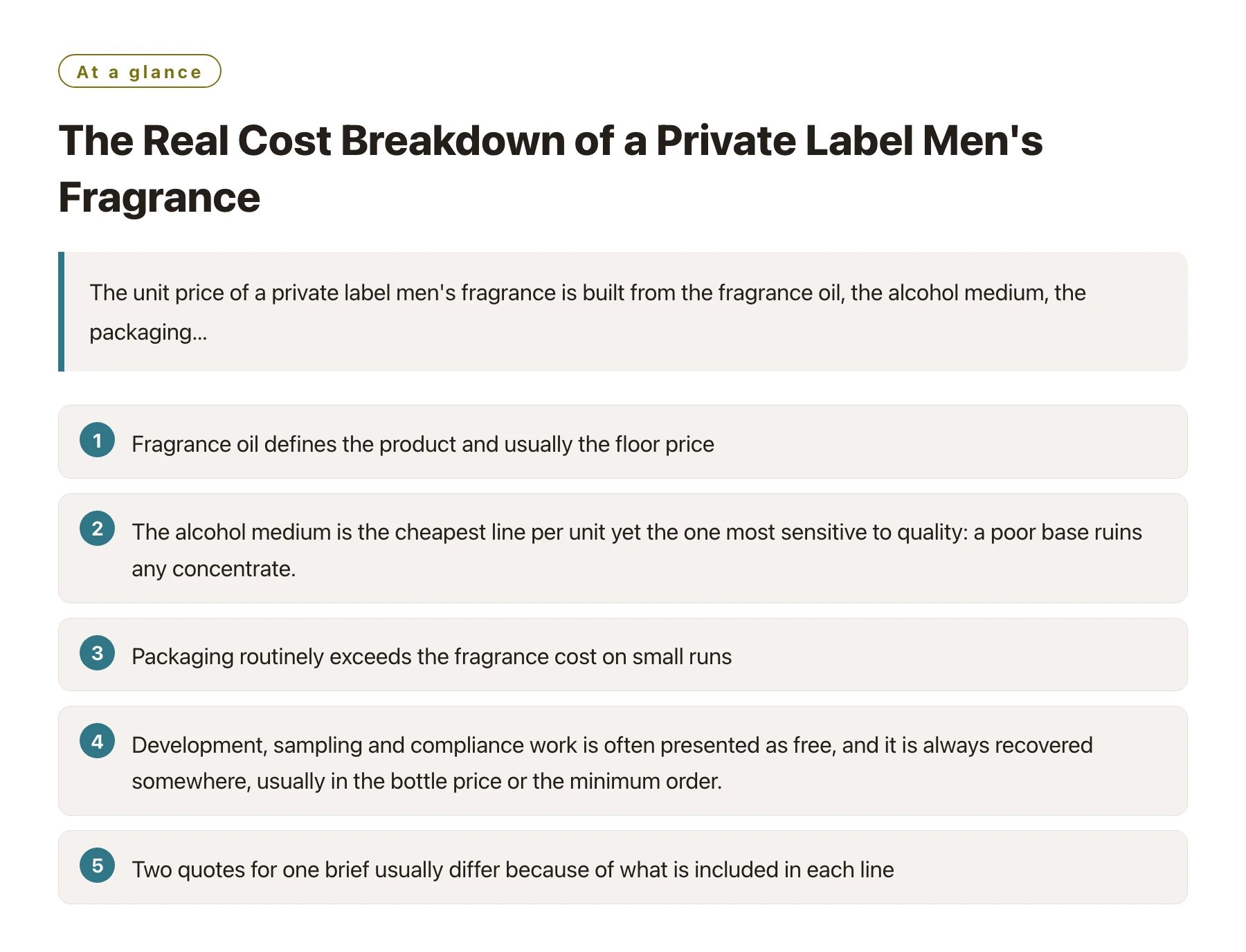
- Fragrance oil defines the product and usually the floor price, but it occupies a modest share of the finished bottle volume.
- The alcohol medium is the cheapest line per unit yet the one most sensitive to quality: a poor base ruins any concentrate.
- Packaging routinely exceeds the fragrance cost on small runs, and custom moulds only enter the unit price once amortised across the order.
- Development, sampling and compliance work is often presented as free, and it is always recovered somewhere, usually in the bottle price or the minimum order.
- Two quotes for one brief usually differ because of what is included in each line, not because one factory is intrinsically cheaper.
Every conversation about private label fragrance cost starts with the same phrase: 'what is the unit price?' The phrase is nearly useless on its own, because the unit price is the sum of four very different cost streams, and suppliers draw the boundaries between them in different places.
The useful version of the question is line by line: what does the fragrance oil cost, what does the bottle and decoration cost, what does filling and packing cost, and what development work is sitting silently inside those numbers?
This breakdown uses the structure a factory actually uses, with the levers that move each line.
The four streams, and what moves them
A men's fine fragrance is, at its simplest, aromatic compounds diluted in alcohol, put in a bottle and sold in a box [1]. Every cost in the quotation belongs to one of those four streams, and each stream has its own economics.
The fragrance oil is priced by the kilo and consumed at a fixed percentage, so its contribution to the unit cost is concentration times oil price. The packaging is priced per piece, and on a low-volume first order it is often the largest single line.
Why the oil line deserves attention out of proportion to its volume
The oil is where the product is won or lost, and where a supplier can legitimately charge very different prices for the same brief, depending on the materials and the perfumer's time behind the accord. It is also the line where a too-cheap quote usually means a compromised base.
Where the hidden costs sit
Sampling fees, development time, stability work and document preparation rarely appear as lines on the first quotation. They are recovered through the minimum order, the bottle price or a separate development invoice. None of these is a problem; a quotation that makes all of them visible is simply easier to compare.
The cost lines, side by side
| Cost line | What drives it | Where it hides |
|---|---|---|
| Fragrance oil (concentrate) | Material selection, concentration percentage, perfumer time | Can be quoted per kilo or silently blended into the unit price |
| Alcohol and water medium | Purity grade, denaturant, fill volume | Seldom on the quotation; assume it is inside the bottle price |
| Bottle, cap and pump | Glass quality, decoration, order volume | Custom tooling only appears once amortised |
| Filling, assembly and packing | Line setup, pack complexity, labelling | Setup charges can be spread across the order or billed once |
| Development and sampling | Number of rounds, modifications, stability work | Often 'free' in words, recovered in MOQ or pricing |
| Compliance documents | Market-specific ingredient and safety files | Sometimes itemised, sometimes absorbed |
Read the last column first. The suppliers that itemise hidden costs are not more expensive; they are merely giving you a quotation you can audit.
Reading a men's fragrance quotation
With the streams separated, the comparison becomes mechanical. Take the same brief, the same fill volume and the same bottle, send it to three factories, and compare line by line rather than by total. The differences that remain after that are real differences in materials or margin.
For a men's line, two extra checks matter. First, look at what concentration the price assumes, because the difference between an eau de toilette and an eau de parfum fill is mostly oil consumption. Second, look at the packaging assumptions, because men's lines are often sold on the bottle as much as the scent.
A structured way to compare suppliers is to read how they present their own pricing thinking. When a manufacturer publishes guidance on comparing fragrance manufacturing quotes and how different programmes are priced, the quotation you receive from it tends to be structured the same way. The same reading applies to the supplier's own positioning: a company such as Xuelei Fragrances describes its service scope publicly, which tells you which cost lines it is used to explaining before you ever ask.
It is also worth asking what the same programme would cost in private label fragrance production specifically, because private label programmes usually share development across the supplier's catalogue, which bends the cost curve differently from a fully custom project.
The one number that should worry you more than the total
The minimum order. It determines how much cash is committed before the product is proven, and it is where hidden development cost is most often parked. A low unit price with a high minimum order is a different deal from a fair unit price with an honest minimum.
The practical rule: never negotiate the total before you understand the lines, and never accept a 'free development' claim without asking where it is recovered. The suppliers that answer honestly are the ones worth negotiating with.
Why the label adds cost you cannot see
In regulated markets the finished product carries an ingredient list built from a documented substance list, and that documentation has to exist before the label is printed [2]. Quality testing for release adds a further layer [3]. Neither item is large, but both are non-negotiable, and a quote that omits them is a quote that will surface the cost later.
Sources
- Wikipedia: Perfume —— An encyclopaedic overview of perfume covering definitions, history, the note structure of a fragrance and concentration terminology (background reference only).
- EU CosIng — Cosmetic Ingredient Database (European Commission) —— The European Commission's CosIng database of cosmetic ingredients, listing ingredient functions, restrictions and labelling requirements under EU cosmetics law.
- SGS: Cosmetics, Personal Care & Household Testing —— Testing, inspection and certification services for cosmetics and personal care, including microbiological, stability and safety testing aligned with cosmetics GMP.
Frequently asked questions
What is the most expensive part of a small private label fragrance order?
On a small run, packaging usually is, because tooling and minimums are shared across fewer units. On a larger run, the fragrance oil becomes the dominant line as volume grows.
Does a higher concentration always mean a higher unit cost?
Yes, because the oil is the most expensive ingredient by weight. The practical question is whether the market you sell into justifies the extra cost, which is a positioning decision, not a manufacturing one.
Why do two factories quote very different prices for the same brief?
Usually because they draw the cost lines differently: what one includes in the bottle price, another bills as a development fee or pushes into the minimum order. Compare line by line after sending an identical brief.
Is development cost really free in private label programmes?
No. Development time is recovered somewhere, typically through the minimum order, a sampling fee or a modestly higher bottle price. A supplier that explains where it is recovered is easier to plan around.
Should I negotiate the minimum order or the unit price?
Both, but in that order. The minimum order decides how much cash you commit before the product is proven, and it is the number most likely to contain hidden development cost.
Visit the Salon